


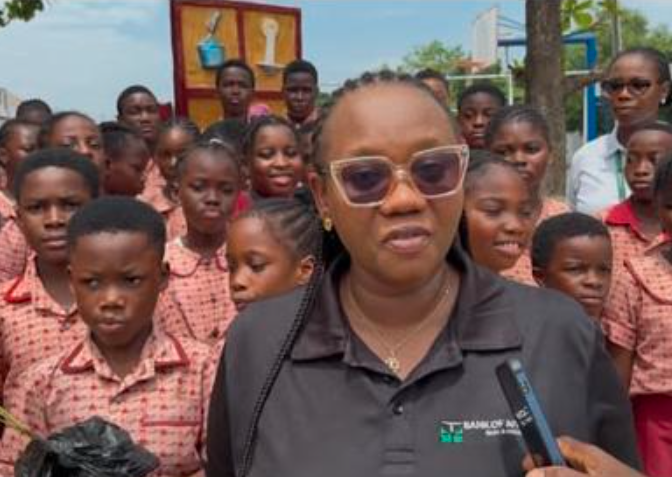
In a bold move that marries environmental responsibility with community development, Bank of Africa Ghana has launched a nationwide initiative that brings together schools, students, and banking professionals around two shared goals: a greener Ghana and a financially literate next generation. The programme, which combines hands-on tree planting activities with structured financial education, signals the bank’s intention to play a far broader role in Ghanaian society than traditional banking alone.
The initiative recently made one of its first public stops at Ford International School in Teshie Nungua, where a delegation from Bank of Africa engaged with students and teachers in what proved to be an energetic and purposeful afternoon. Trees were planted across the school grounds, conversations about climate responsibility filled classrooms, and students who may never have considered opening a savings account found themselves discussing the basics of personal finance. It was, by every measure, an unusual school day — and deliberately so.
More Than a Tree Planting Exercise
At first glance, the sight of bank officials in school uniforms, shovels in hand, might seem like a curious photo opportunity. But Leila Pentsil, Head of Marketing and Corporate Communications at Bank of Africa Ghana, was quick to frame the initiative in wider terms.
“We are collaborating with schools across the country not only to support environmental sustainability through tree planting but also to deepen financial inclusion through education,” she explained during the visit.
Pentsil’s words reflect a growing recognition among institutions — both public and private — that environmental and economic challenges in Ghana are deeply intertwined. A generation that grows up without financial literacy is poorly equipped to build resilient livelihoods. Equally, a generation indifferent to the health of its natural environment inherits compounding crises. Bank of Africa’s programme attempts to address both deficits at once, using the school environment as a natural gathering point for young minds still in the process of forming habits and values.
The tree planting component is not merely symbolic. Ghana, like many countries across West Africa, has faced significant pressure on its forest cover in recent decades, driven by agricultural expansion, charcoal production, and rapid urbanisation. Every tree planted in a school compound serves multiple purposes: it provides shade, improves air quality, teaches students about ecology, and contributes — however modestly — to national reforestation targets. When students plant a tree themselves, the act creates a personal connection to environmental stewardship that no classroom lecture fully replicates.
Building Financial Habits Early
The financial literacy dimension of the programme draws on well-established evidence that habits around money are shaped early in life. Children who learn to save, budget, and understand the basics of interest and credit are significantly more likely to make sound financial decisions as adults. Yet in Ghana, as in much of sub-Saharan Africa, formal financial education remains inconsistently delivered in schools, and millions of households operate largely outside the banking system.
Pentsil underscored the long-term thinking behind this approach. “Introducing students to financial education at an early age will help them build responsible financial habits and prepare them for the future,” she said.
For Bank of Africa, whose operations span more than 30 countries across Africa, expanding financial inclusion is both a social mission and a business imperative. Reaching young people through school partnerships is a strategic way to build familiarity with formal banking among communities that may have had limited exposure to it. When a student learns about saving accounts, interest, and financial planning in a trusted educational setting, the psychological and practical barriers to accessing formal financial services begin to lower.
The sessions at Ford International School were designed to be interactive and age-appropriate, moving away from dry lectures toward conversations that connected financial concepts to students’ everyday lives. Teachers at the school, who participated alongside their pupils, described the sessions as a welcome complement to the existing curriculum.
Community Investment as a Core Mandate
What distinguishes this programme from a typical corporate social responsibility exercise is the explicit ambition to scale it. Bank of Africa has indicated that the Ford International School visit is one of many planned across the country, with the bank aiming to reach schools in diverse regions and communities throughout Ghana. The goal is not a one-off event but a sustained, rolling engagement that deepens over time.
Pentsil captured the philosophy behind this commitment plainly. “Our commitment is not only to banking but also to investing in communities. Through initiatives like this, we are nurturing both the environment and the next generation,” she said.
The framing of community investment as a core mandate — rather than a peripheral add-on to the bank’s commercial activities — reflects shifting expectations of what responsible institutions should look like. Across Ghana and across the continent, businesses that demonstrate genuine engagement with local challenges are finding that trust, reputation, and long-term customer loyalty follow.
Students and teachers at Ford International School responded warmly to the initiative. Participants described the experience as genuinely meaningful, noting that the combination of physical activity, environmental education, and financial learning made for an unusually engaging programme. Several students expressed pride in having personally planted trees that would grow alongside them through their school years — a tangible legacy of the bank’s visit.
A Model Worth Watching
As Bank of Africa continues rolling out the initiative to schools nationwide, its approach offers a model that other institutions — banks, businesses, and government agencies alike — might consider adapting. The programme’s strength lies in its integration: rather than treating environmental work and financial education as separate corporate giving buckets, it weaves them together in a way that reinforces both messages.
For the students of Ford International School and the many more schools yet to be visited, the programme represents something straightforward and valuable: a day when the adults around them showed up not to sell something, but to invest in them. In that sense, Bank of Africa’s nationwide school initiative may prove to be one of its most consequential long-term assets — one measured not in cedis, but in the habits, values, and capabilities of the generation now coming of age in Ghana.